
You know those shallow basins (also sometimes called playa lakes, mudholes or buffalo wallows) in your field that fill up after a good Kansas rain? Those are playas, and they’re more powerful than they look.
Playas help recharge the Ogallala Aquifer, naturally filter groundwater, and create vital habitat for wildlife. With the right management, your playa can work for you; improving water quality, supporting your land, and protecting resources for the next generation.
Combined with smart water management, including reducing aquifer overuse, they can be part of a long-term solution for communities, too.
The City of Goodland has partnered with Tomorrow’s Water, a multi-state, multi-partner effort to support playa restoration in and around Goodland. Tomorrow’s Water connects people, playas, and the Ogallala Aquifer to help towns and communities secure their water future.
Restore Your Playa — Benefit Your Operation & Future Generations
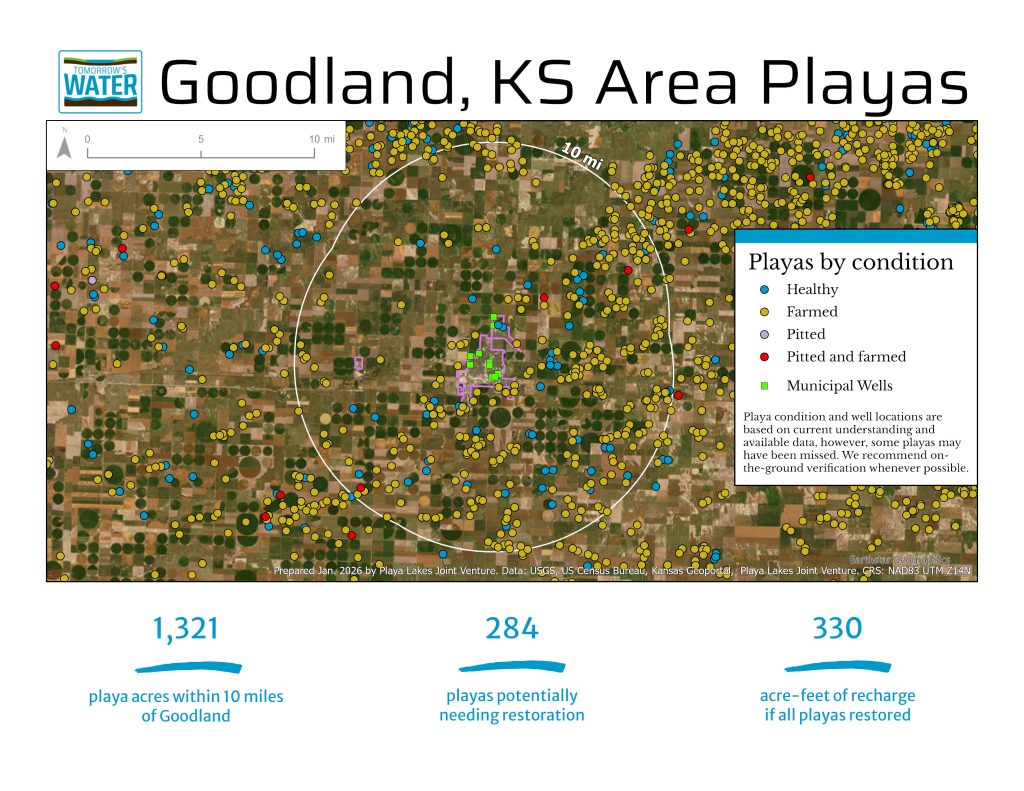
Within ten miles of Goodland, there are 1,321 acres of playas, with 284 playas that can potentially be restored. If all playas within this area are restored, they could potentially provide 330 acre-feet of recharge to the aquifer annually. Landowners in the area are in a unique position to help secure the region’s water future. Restoring these natural recharge wetlands is key to replenishing groundwater and providing critical habitat for birds and other wildlife.
Did you know that you can receive revenue from conservation programs for restoring playas on your land while also benefiting your operation and supporting future generations?
Benefits of Playas
Found at the lowest point of a watershed, playas are round, shallow basins lined with clay soil that collect and hold rainfall and runoff, forming temporary wetlands. Playas are recharge wetlands, meaning water flows through them to the underlying aquifer.
Playas are a primary source of groundwater recharge, contributing up to 95 percent of water flowing to the aquifer, with recharge rates in playas 10 to 1,000 times higher than under other areas. According to USGS Circular: Recharge Rates and Chemistry Beneath Playas of the High Plains Aquifer, the average recharge rate across the playa region is about three inches of water the size of the playa moving toward the aquifer each year. In addition, water reaching the aquifer through playas is of higher quality than that going through other pathways because healthy playas are water filtration systems, reducing contaminants reaching the groundwater.
Over the years, many playas have become degraded and no longer function properly to provide benefits. The primary focus of playa restoration is on returning them to their historic hydrological function, by removing accumulated sediment, filling drainage features, redirecting water back into the playa, and planting native vegetative buffers. Healthy playas provide cleaner water going back into the Ogallala aquifer that can support families and towns, recreational activities, and flood control.
Although playas are a primary source of recharge, irrigation pumping from the aquifer greatly exceeds groundwater recharge from playas. Communities can proactively address a declining water supply by restoring playas and adopting irrigation practices that reduce the impacts from aquifer overuse. Once water use has been reduced, healthy playas can provide a sustainable source of future water.
Tomorrow’s Water, which supports communities in these efforts, is an adaptive, collaborative process in which local communities partner with conservation organizations to create an actionable plan to stabilize their water supply – with a focus on incorporating playa conservation as part of broader water quantity and quality efforts.
By reducing aquifer overuse, restoring playas, and managing runoff within playa watersheds, communities can ensure a sustainable water supply for communities and future generations.
Take the first step today in learning how to put your playas to work.
If you are a landowner interested in restoring a playa on your land, reach out to Bernadette Mills, Playa & Water Conservation Outreach Specialist, at bmills.kacd@gmail.com or call 785-772-5763. You can also visit PlayasWorkForKansas.com/Tomorrows-Water to learn more.
Bernadette is a Playa & Water Conservation Outreach Specialist for Northwest Kansas and works for the Kansas Association of Conservation Districts as part of the Tomorrow’s Water team. Tomorrow’s Water is a partnership-driven conservation initiative, and the team is made up of folks from several different organizations, including Bird Conservancy of the Rockies, Ducks Unlimited, and Playa Lakes Joint Venture.
Bernadette works with community leaders to incorporate playa restoration into water conservation efforts and plans, helping landowners in the community determine what is needed to restore their playas, and connecting playa owners with conservation programs, financial assistance, and contractors to make the restoration feasible.